
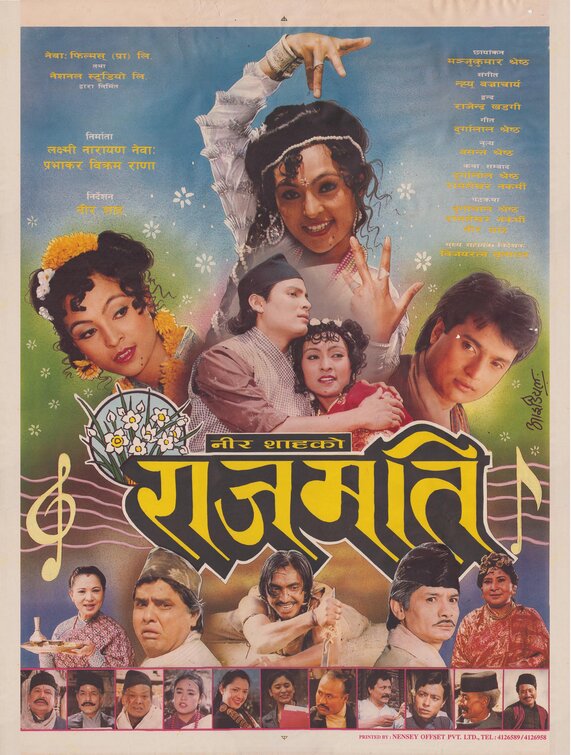
Rajamati
Rajamati (1996), directed by Neer Bikram Shah, is a landmark Nepal Bhasa film inspired by a centuries‑old Newar folk ballad that remains deeply rooted in Kathmandu Valley’s cultural memory. The story centers on Rajamati, a young woman from Taha Nani, Itum Baha, a historic neighborhood in central Kathmandu. Her life unfolds through a series of emotionally painful and unsuccessful relationships, shaped by family expectations, social norms, and the constraints placed on women in traditional Newar society.Rajamati’s journey reflects the struggles of a “luckless girl” whose desires and choices are repeatedly overshadowed by the decisions of others. The narrative draws heavily from the famous ballad Rajamati, which describes her beauty, her daily life, and the emotional turmoil surrounding her marriage—ultimately arranged against her wishes. The film weaves these lyrical elements into a dramatic portrayal of heartbreak, resilience, and cultural identity.Supported by an ensemble cast including Hisila Maharjan, Shree Krishna Shrestha, Madan Krishna Shrestha, Hari Bansha Acharya, Subhadra Adhikari, and Rajendra Khadgi, the film brings Newar heritage to the screen with authenticity. Its music, rooted in traditional melodies, reinforces the emotional weight of Rajamati’s story and the historical significance of the original song, which has been recorded and reinterpreted for over a century.Released on 9 February 1996, Rajamati remains one of the most culturally important Nepal Bhasa films, preserving a beloved folk narrative while highlighting the lived experiences of Newar women across generations.
Neer Shah
Neer Shah
Nhyoo Bajracharya
0
Synopsis
Rajamati (1996), directed by Neer Bikram Shah, is a landmark Nepal Bhasa film inspired by a centuries‑old Newar folk ballad that remains deeply rooted in Kathmandu Valley’s cultural memory. The story centers on Rajamati, a young woman from Taha Nani, Itum Baha, a historic neighborhood in central Kathmandu. Her life unfolds through a series of emotionally painful and unsuccessful relationships, shaped by family expectations, social norms, and the constraints placed on women in traditional Newar society.
Rajamati’s journey reflects the struggles of a “luckless girl” whose desires and choices are repeatedly overshadowed by the decisions of others. The narrative draws heavily from the famous ballad Rajamati, which describes her beauty, her daily life, and the emotional turmoil surrounding her marriage—ultimately arranged against her wishes. The film weaves these lyrical elements into a dramatic portrayal of heartbreak, resilience, and cultural identity.
Supported by an ensemble cast including Hisila Maharjan, Shree Krishna Shrestha, Madan Krishna Shrestha, Hari Bansha Acharya, Subhadra Adhikari, and Rajendra Khadgi, the film brings Newar heritage to the screen with authenticity. Its music, rooted in traditional melodies, reinforces the emotional weight of Rajamati’s story and the historical significance of the original song, which has been recorded and reinterpreted for over a century.
Released on 9 February 1996, Rajamati remains one of the most culturally important Nepal Bhasa films, preserving a beloved folk narrative while highlighting the lived experiences of Newar women across generations.